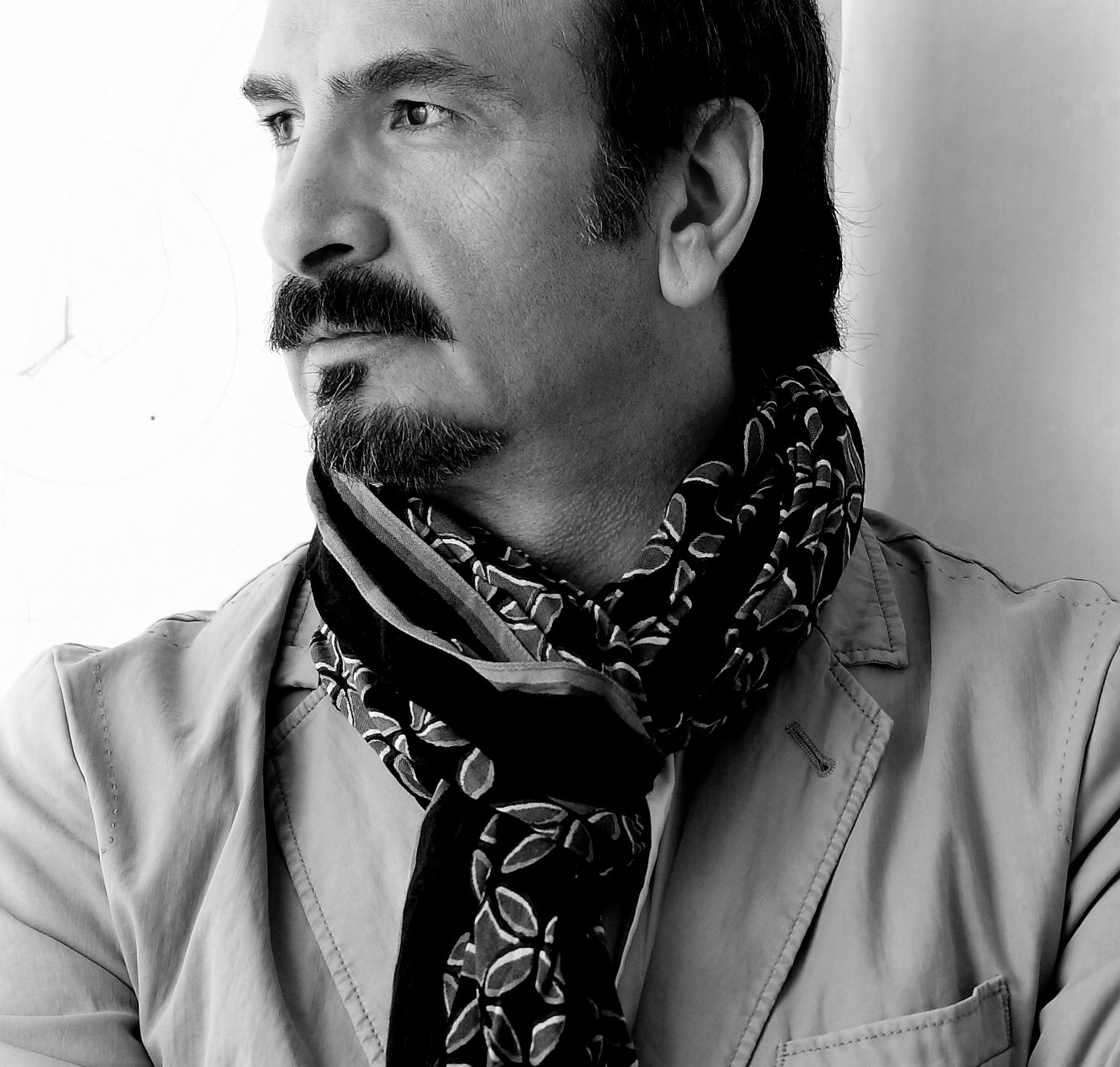
Ali Konya was born in Istanbul. His childhood was spent in the workshops of Armenian, Rum, and Italian craftsmen in Kumbaraci Yokus. He was a good butafor, was working on sculpture and painting. After his education at the Istanbul Academy of Fine Arts, he started his career as an architect designer.
In 1991, he pioneered the Avantgarde style in Turkey. In the following period, he continued this style in all his designs, from industrial design to interior and architectural designs. Today, rather than the avantgarde, a unique Ali Konya style has been formed in lines and designs. During the period he went to America, he closely observed and experienced the art trends and art movements prevailing worldwide, and spent the period with his professional observations, researches, listening, discoveries, presentations, and conferences. Throughout his 35 years of profession, he has skillfully combined functionality and aesthetics with the Ali Konya line and has signed award-winning projects in Turkey and abroad.
He will continue to produce designs in a creative way on behalf of humanity and all living beings in the future, as he has done in the past, today, and in the future, using science, aesthetics, and all kinds of art. Ali Konya is a designer who uses all branches of art in his design phases, not only limited to architecture and interior architecture lines.
.
.
.
INTENTOSECT
ALIKONYA’s Ontological – Phenomenological Conceptual Framework
INTENTOSECT is a field of consciousness positioned before form. Rather than an aesthetic method, it represents an attempt to comprehend the ontological density of existence prior to its transformation into form. Form is not the beginning; it is the visible outcome.
Before every form, there exists an order of being. This order is not measurable but ontological. It contains fields of tension, centers of density, layers of void, and axes of orientation. INTENTOSECT proposes the reading and interpretation of this order. Form becomes the manifestation of that reading.
At the core of this approach lies the Ontology of the Essential Point. A point is not merely a geometric origin; it is the condensed nucleus of existence. Each essential point carries a field of memory. This memory is not a record of the past but a potential-bearing intensity of consciousness. A line is the continuity of essential points that have gained direction. A surface is the spatial organization of memory. Volume is the spatial crystallization of meaning. Thus, form ceases to be a material construct and becomes the visible configuration of consciously positioned intensities.
INTENTOSECT does not seek to represent a concept directly. It first examines the topography of being inherent within that concept. Where does density accumulate? Where does it release? Where does silence emerge? Where does tension form? These questions are not technical but phenomenological. Experience precedes the object. The object acquires meaning only through experience.
This consciousness does not distinguish between disciplines. Placing pigment in painting, carving matter in sculpture, establishing an axis in architecture, or defining a form in furniture design are manifestations of the same ontological ground. A column is not merely structural; it is an axis of orientation. A wall is not simply a boundary; it is a plane of memory. A surface of contact is not merely functional; it is a relational field.
Ultimately, this approach establishes an Architecture of Consciousness. Space is not physical organization alone but the placement of intensities and memories. Light is not illumination but a mode of unveiling. Void is not absence but a potential field of existence.
INTENTOSECT does not separate art from architecture; it unites them on the same ontological foundation. Disciplines may shift, yet the memory of the essential point remains constant.
Thus, it is not a matter of producing form.
It is a matter of positioning existential intensities.
INTENTOSECT is the name of this positioning.
— ALİKONYA